



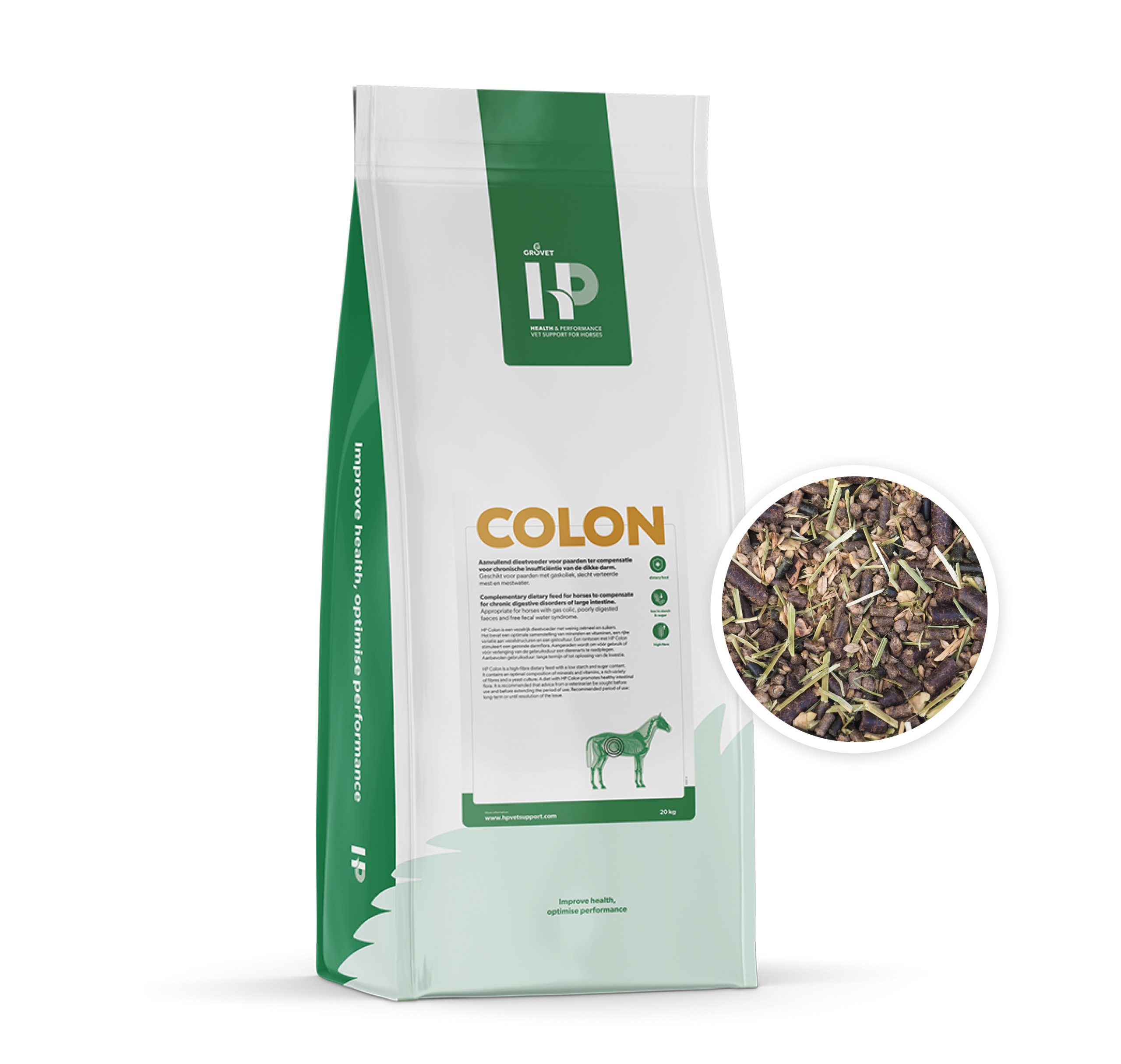
HP Colon (formerly Bonpard Colon)
HP Colon by Health & Performance is a specially formulated dietary feed for horses experiencing chronic digestive problems affecting the large intestine. It has been developed to support the intestinal microbiome and fiber digestion, particularly in horses experiencing free fecal water, poorly digested manure, loose stools, or recurring digestive problems.
HP Colon was previously sold under the name Bonpard Colon. Following the transition from Bonpard to Health & Performance, the original formulation has been retained.
The large intestine plays an essential role in equine digestion. In the cecum and colon, billions of microorganisms break down dietary fiber from hay, grass, and other plant-based feed ingredients. During this fermentation process, volatile fatty acids are produced, providing an important source of energy for the horse.
When the intestinal microbiome becomes unbalanced, digestion and manure consistency may be affected. Some horses develop recurring free fecal water, loose stools, or poorly digested manure. Changes in the diet, forage quality, and the amount of starch reaching the large intestine can all contribute to these problems.
HP Colon combines several fiber sources with live yeast cultures of Saccharomyces cerevisiae (Yea-Sacc® 1026). The dietary fiber supports normal fermentation, while the yeast cultures help maintain a favorable environment for the microorganisms responsible for fiber digestion.
The feed is also enriched with vitamins, minerals, and trace elements, making it suitable as part of a comprehensive nutritional program for horses requiring long-term dietary management.
Properties and benefits
HP Colon contains several ingredients that contribute to normal intestinal function and balanced digestion.
- Supports the intestinal microbiome: contains live yeast cultures of Saccharomyces cerevisiae (Yea-Sacc® 1026), which help maintain a favorable environment for microorganisms in the cecum and colon.
- High-fiber formulation: ingredients such as alfalfa, apple pulp, oat hulls, and flaxseed hulls provide different types of dietary fiber to support normal intestinal fermentation.
- Supports fiber digestion: the combination of dietary fiber and live yeast cultures helps support the activity of fiber-digesting microorganisms.
- Helps maintain a stable intestinal environment: Yea-Sacc® is used to support microbial balance in the large intestine, particularly when fermentation conditions change.
- Processed starch sources: the specially processed grain ingredients are selected to promote starch digestion in the small intestine.
- Vegetable fats: flaxseed oil provides energy and essential fatty acids as part of the daily diet.
- Vitamins and minerals: the formula contains vitamin A, vitamin D3, vitamin E, vitamin C, biotin, and several trace elements.
- Suitable for long-term nutritional support: HP Colon can be incorporated into a specialized feeding program for horses experiencing persistent digestive problems.
According to the manufacturer, HP Colon contains 17.4% crude fiber, 7.5% crude fat, 16.5% starch, and 4.8% sugar. The combined starch and sugar content is therefore 21.3%.
HP Colon has been developed as a fiber-rich dietary feed but is not starch-free. For horses requiring particularly strict starch and sugar restrictions due to metabolic disorders or other health conditions, the composition of the complete diet should be carefully evaluated.
When to use HP Colon?
HP Colon is particularly suitable for horses experiencing recurring problems affecting the large intestine, including:
- Horses regularly experiencing free fecal water (fecal water syndrome).
- Horses with recurring loose stools or variable manure consistency.
- Horses with poorly digested feed and visible coarse feed particles in their manure.
- Horses with chronic digestive problems that may benefit from additional support for their intestinal microbiome.
- Horses that are sensitive to changes in feed or forage quality.
- Horses requiring a specialized long-term feeding program to support normal large intestinal function.
Free fecal water and loose manure can have several underlying causes. In addition to diet composition, dental problems, parasitic diseases, intestinal inflammation, and changes in the intestinal microbiome may play a role.
For horses experiencing recurring symptoms, it is therefore important to evaluate not only the concentrate feed but also forage quality and quantity, feeding management, and overall health.
HP Colon is designed to provide nutritional support for horses with chronic digestive problems and can be incorporated into a broader management program to support intestinal function and normal manure consistency.
Composition
Barley flakes, alfalfa, apple pulp, oat hulls, flaxseed hulls, wheat bran, carob, flaxseed oil, alfalfa stems, toasted soybean flakes, flaxseed, sodium chloride, wheat middlings, dicalcium phosphate, wheat, calcium carbonate, magnesium oxide, sunflower seed meal, and live yeast cultures (Yea-Sacc® 1026).
Added nutrients include vitamin A, vitamin D3, vitamin E, vitamin C, biotin, copper, selenium, iodine, zinc, and manganese.
As a zootechnical feed additive, HP Colon contains live yeast cultures of Saccharomyces cerevisiae. It also contains BHA and BHT as technological additives.
The different fiber sources and added live yeast cultures are the main ingredients selected to support normal intestinal function.
Directions for use and dosage
HP Colon is fed daily in combination with suitable forage. According to the Health & Performance feeding program, coarse-stemmed hay forms the foundation of the diet alongside HP Colon.
One level standard feed scoop contains approximately 920 g of HP Colon. Weighing the feed regularly is recommended, as the actual weight per scoop may vary.
The recommended amount depends on the horse’s body weight and average workload. The following quantities are taken from the manufacturer’s feeding program and are expressed per 100 kg of body weight per day.
Horses and ponies weighing less than 250 kg
- At rest: 480 g HP Colon and 1.3 kg coarse-stemmed hay.
- Light work: 500 g HP Colon and 1.7 kg hay.
- Moderate work: 600 g HP Colon and 1.9 kg hay.
- Heavy work: 700 g HP Colon and 2.0 kg hay.
Horses weighing 250–450 kg
- At rest: 400 g HP Colon and 1.4 kg coarse-stemmed hay.
- Light work: 500 g HP Colon and 1.6 kg hay.
- Moderate work: 550 g HP Colon and 1.7 kg hay.
- Heavy work: 600 g HP Colon and 1.8 kg hay.
Horses weighing more than 450 kg
- At rest: 300 g HP Colon and 1.3 kg coarse-stemmed hay.
- Light work: 400 g HP Colon and 1.5 kg hay.
- Moderate work: 500 g HP Colon and 1.5 kg hay.
- Heavy work: 550 g HP Colon and 1.6 kg hay.
Example for a horse weighing 600 kg (1,320 lb) performing light work:
- HP Colon: 2.4 kg daily.
- Coarse-stemmed hay according to the manufacturer’s feeding program: 9.0 kg daily.
This is an example calculation based on the manufacturer’s recommendations. The actual forage allowance must be adjusted according to the horse’s body weight, the nutritional value and dry matter content of the forage, body condition, and individual requirements. Many horses may require additional forage.
Gradual dietary transition
The manufacturer recommends gradually transitioning from the existing feed to HP Colon over approximately three weeks.
Gradually replace the current concentrate feed with HP Colon until the recommended daily amount is reached. This allows the intestinal microbiome time to adapt to the new composition of the diet.
Divide the daily amount of HP Colon between at least two feedings, preferably after providing forage.
For healthy intestinal function, it is essential that the horse receives sufficient high-quality forage. Avoid abrupt dietary changes and prolonged periods without forage.
Always provide unrestricted access to fresh drinking water and make a salt block available.
Important: HP Colon already contains added vitamins and minerals, including selenium. Do not automatically combine it with other comprehensive vitamin and mineral supplements. The complete diet should be adapted to the horse’s individual nutritional requirements.
Packaging and duration of use
HP Colon is supplied in a 20 kg bag.
The duration of use depends on body weight and the daily feeding amount:
- 1.0 kg daily: approximately 20 days.
- 1.5 kg daily: approximately 13 days.
- 1.8 kg daily: approximately 11 days.
- 2.0 kg daily: approximately 10 days.
- 2.4 kg daily: approximately 8 days.
- 3.0 kg daily: approximately 6–7 days.
For a horse weighing 600 kg (1,320 lb) performing light work, the manufacturer’s example feeding amount is 2.4 kg daily. A 20 kg bag therefore lasts approximately eight days.
Important shelf-life information: according to the manufacturer, HP Colon has a maximum shelf life of six months from the manufacturing date. This does not mean six months from the purchase date or from opening the bag.
Always check the expiration date printed on the packaging. Store HP Colon tightly closed in a cool, dry place, protected from moisture and direct sunlight.
Advice from the equine veterinarian
A healthy intestinal microbiome is essential for normal digestion and the overall health of horses. In the cecum and large intestine, microorganisms break down substantial amounts of dietary fiber. When this fermentation process functions properly, it not only provides energy but also helps maintain a stable intestinal environment.
For horses experiencing recurring free fecal water, loose stools, or poorly digested manure, I always carefully evaluate the composition of the daily diet. Forage quality, the amount of starch-rich concentrate feed, and recent dietary changes are particularly important considerations.
I consider HP Colon an interesting dietary feed because it combines different fiber sources with live yeast cultures of Saccharomyces cerevisiae (Yea-Sacc® 1026).
The various fiber sources provide nutrients for microorganisms in the large intestine. The added yeast cultures support the microbial environment and can promote the activity of fiber-digesting bacteria. This makes HP Colon a suitable nutritional option for horses that may benefit from additional support for intestinal fermentation.
The use of specially processed starch sources is another interesting feature. Efficient starch digestion in the small intestine helps prevent excessive amounts of undigested starch from reaching the large intestine, where it could disrupt normal fermentation.
However, HP Colon itself contains 16.5% starch and 4.8% sugar. For horses with insulin dysregulation or other conditions requiring particularly strict restrictions on starch and sugar intake, I therefore always evaluate the complete diet.
I particularly recommend HP Colon for horses experiencing persistent or recurring problems with manure consistency, including free fecal water or poorly digested manure, when nutrition appears to play an important role. Targeted dietary adjustments can help support normal intestinal function.
I also pay considerable attention to forage. Not only its quantity but also its quality, digestibility, and feeding frequency are important. Suitable forage is the foundation of healthy intestinal function. Specialized feeds can support this foundation but cannot replace it.
When changing a horse’s feed, I recommend a gradual transition over approximately three weeks, as advised by the manufacturer. The microorganisms in the large intestine need time to adapt to new dietary ingredients.
If a horse suddenly develops severe diarrhea, signs of colic, fever, or a marked reduction in appetite, prompt veterinary examination is essential. In these situations, identifying and appropriately treating the underlying cause is a priority.
My recommendation is to use HP Colon as part of an individualized feeding program for horses experiencing chronic large intestinal problems. Particularly in cases of free fecal water, variable manure consistency, and poorly digested manure, a well-balanced combination of suitable forage, fiber-rich feed, and live yeast cultures can provide valuable nutritional support.


Reviews
There are no reviews yet.