



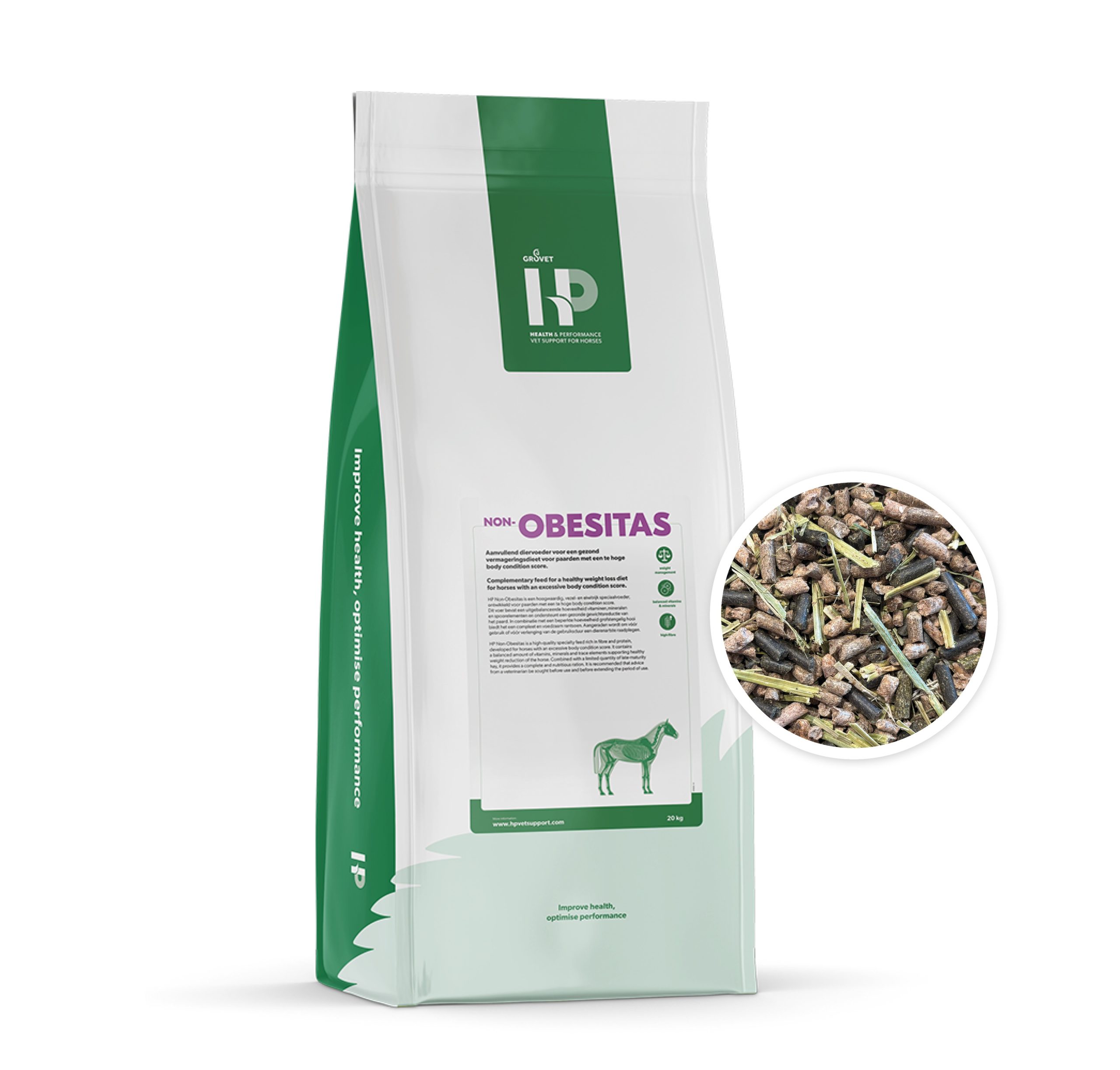
HP Non-Obesitas (formerly Bonpard Non-Obesitas)
HP Non-Obesitas by Health & Performance is a specially formulated complementary feed for overweight horses and ponies. It has been developed as part of a responsible weight-loss program, helping horses gradually reduce their body weight while supporting normal muscle function and maintaining an adequate nutritional intake.
HP Non-Obesitas was previously sold under the name Bonpard Non-Obesitas. Following the transition from Bonpard to Health & Performance, the original formulation has been retained.
Many horses and ponies consume more energy each day than they actually use. Over time, this can lead to excess body weight, which not only affects movement and performance but also increases the risk of health problems. Laminitis and disturbances in insulin regulation are particularly important concerns in overweight horses.
For healthy weight loss, a horse must consume less energy than it expends. At the same time, sufficient protein, vitamins, minerals, and fiber must remain available. A weight-loss diet therefore involves more than simply feeding less. The composition and quantity of the entire diet must be carefully adjusted.
HP Non-Obesitas has been developed according to this nutritional approach. It contains selected fiber sources, high-quality proteins, and a comprehensive combination of essential vitamins and minerals. This makes it a practical component of a targeted feeding program for horses that need to lose weight.
Properties and benefits
HP Non-Obesitas combines a controlled energy supply with important nutrients that remain essential during weight loss.
- Supports controlled weight loss: the relatively low energy density helps limit calorie intake as part of an appropriately managed feeding program.
- High-fiber formulation: ingredients such as alfalfa, oat hulls, and flaxseed hulls provide dietary fiber and support normal intestinal function.
- Low starch and sugar content: contains 7.8% starch and 3.7% sugar, for a combined total of 11.5%. This makes it particularly interesting for horses requiring a controlled intake of these carbohydrates.
- High-quality protein: with 15.5% crude protein and several protein sources, the feed contributes to the daily supply of amino acids needed to maintain muscle mass.
- Vitamins and minerals: the formula is enriched to help maintain an adequate nutritional supply when overall feed intake is restricted.
- Vitamin E and selenium: support antioxidant defense mechanisms and normal muscle function.
- Supports overall condition: helps provide essential nutrients while following an energy-restricted feeding program.
According to the manufacturer, HP Non-Obesitas contains 15.5% crude protein, 19.5% crude fiber, 2.5% crude fat, 7.8% starch, and 3.7% sugar. Its energy value is 0.67 EWpa per kilogram.
HP Non-Obesitas is not a weight-loss product that independently causes horses to lose weight. Instead, it supports a feeding program in which total energy intake is lower than energy expenditure while sufficient essential nutrients continue to be provided.
When to use HP Non-Obesitas?
HP Non-Obesitas has been specially developed for overweight horses and ponies, including:
- Horses with an elevated Body Condition Score (BCS).
- Ponies and easy keepers that gain weight easily.
- Horses that need to lose weight while maintaining an adequate intake of protein, vitamins, and minerals.
- Horses requiring a diet with reduced energy density and controlled starch and sugar intake.
- Overweight horses at increased risk of metabolic disorders, when an adapted feeding program is recommended.
- Horses following a controlled weight-loss program with regular monitoring of body weight and body condition.
Excess body condition increases the risk of several health problems. Obesity is also frequently associated with insulin dysregulation, which plays an important role in the development of endocrinopathic laminitis.
For this reason, it is important to assess not only body weight but also overall body condition and regional fat deposits, particularly along the neck crest.
The most appropriate feeding program depends on the horse’s current weight, target weight, general health, and level of physical activity.
Composition
Alfalfa, oat hulls, flaxseed hulls, soybean meal, wheat middlings, alfalfa stems, molasses, sodium chloride, calcium carbonate, rapeseed meal, sunflower seed meal, dicalcium phosphate, flaxseed, magnesium oxide, flaxseed oil, sunflower oil, rice feed meal, monocalcium phosphate, and soybean oil.
Added nutrients include vitamin A, vitamin D3, vitamin E, vitamin C, biotin, copper, iron, selenium, manganese, cobalt, iodine, and zinc.
The combination of fiber-rich ingredients and protein sources forms the nutritional foundation of the feed. The added vitamins, minerals, and trace elements help maintain an adequate supply of essential nutrients during an energy-restricted feeding program.
Directions for use and dosage
HP Non-Obesitas is fed daily in combination with suitable, low-energy forage and, where appropriate, straw. The feeding program is calculated according to the horse’s target body weight, rather than automatically using its current weight.
The recommended amounts depend on the weight category and activity level. Health & Performance distinguishes between horses receiving approximately one hour of exercise daily and horses that are not being exercised.
One level standard feed scoop contains approximately 820 g of HP Non-Obesitas. Weighing the daily amount is recommended because the actual weight per scoop may vary.
Feeding program for horses receiving approximately one hour of exercise daily
The following quantities are expressed per 100 kg of target body weight per day:
- 100–150 kg: 500 g HP Non-Obesitas and 1.6 kg coarse-stemmed hay. No straw required.
- 151–300 kg: 440 g HP Non-Obesitas and 1.5 kg hay. No straw required.
- 301–450 kg: 400 g HP Non-Obesitas and 1.4 kg hay. No straw required.
- 451–600 kg: 360 g HP Non-Obesitas, 1.3 kg hay, and 100 g straw.
- 601–800 kg: 350 g HP Non-Obesitas, 1.2 kg hay, and 125 g straw.
Example for a horse with a target body weight of 500 kg (1,100 lb) receiving daily exercise:
- HP Non-Obesitas: 1.8 kg daily.
- Coarse-stemmed hay: 6.5 kg daily.
- Straw according to the manufacturer’s feeding program: 0.5 kg daily.
Feeding program for horses that are not being exercised
The following quantities are also expressed per 100 kg of target body weight per day:
- 100–200 kg: 425 g HP Non-Obesitas, 1.15 kg hay, and 100 g straw.
- 201–350 kg: 375 g HP Non-Obesitas, 1.0 kg hay, and 200 g straw.
- 351–500 kg: 350 g HP Non-Obesitas, 1.0 kg hay, and 300 g straw.
- 501–800 kg: 300 g HP Non-Obesitas, 0.9 kg hay, and 300 g straw.
Example for a horse with a target body weight of 500 kg (1,100 lb) that is not being exercised:
- HP Non-Obesitas: 1.75 kg daily.
- Coarse-stemmed hay: 5.0 kg daily.
- Straw: 1.5 kg daily.
Important information about this feeding program: these are the manufacturer’s guidelines and should not be considered universal recommendations for every horse. The amount of forage must be evaluated according to current and target body weight, the nutritional value and dry matter content of the hay, the inclusion of straw, and the individual horse’s health.
A weight-loss program should reduce energy intake while maintaining sufficient fiber intake and chewing time. Excessively restricting forage can cause health and welfare problems. The feeding program should therefore be adjusted if the calculated forage allowance does not meet the individual horse’s requirements.
Gradual dietary transition:
The manufacturer recommends gradually transitioning from the existing diet to HP Non-Obesitas over approximately three weeks.
Divide the daily amount of HP Non-Obesitas between at least two feedings, preferably after providing forage.
Whenever possible, offer hay in a slow feeder and distribute the daily forage allowance across several feeding periods. Avoid prolonged periods without access to feed.
Straw can be included in an appropriate weight-loss diet to help reduce energy intake while maintaining chewing time. Introduce straw gradually and consider the horse’s dental health, water intake, and manure consistency.
Always provide sufficient fresh drinking water and make a salt block available.
Exercise: when the horse’s health allows, regular physical activity supports weight management. However, horses with active laminitis should not be forced to exercise. In these cases, follow the veterinarian’s treatment recommendations.
Once the horse has reached its target weight and body condition, the weight-loss diet should be adjusted to meet maintenance requirements.
Packaging and duration of use
HP Non-Obesitas is supplied in a 20 kg bag.
The duration of use depends on target body weight, activity level, and the daily feeding amount:
- 1.0 kg daily: approximately 20 days.
- 1.5 kg daily: approximately 13 days.
- 1.75 kg daily: approximately 11 days.
- 1.8 kg daily: approximately 11 days.
- 2.0 kg daily: approximately 10 days.
- 2.5 kg daily: approximately 8 days.
For a horse with a target body weight of 500 kg (1,100 lb), the manufacturer’s example feeding programs require approximately 1.75–1.8 kg of HP Non-Obesitas daily. A 20 kg bag therefore lasts approximately 11 days.
Important shelf-life information: according to the manufacturer, HP Non-Obesitas has a maximum shelf life of six months from the manufacturing date. This does not mean six months from the purchase date or from opening the bag.
Always check the expiration date printed on the packaging. Store the feed tightly closed in a cool, dry place, protected from moisture and direct sunlight.
Frequently asked questions about HP Non-Obesitas
Is HP Non-Obesitas the same as Bonpard Non-Obesitas?
Yes. HP Non-Obesitas was previously sold under the name Bonpard Non-Obesitas. The Bonpard brand transitioned to Health & Performance. According to the manufacturer, the feed’s formulation remained unchanged during this rebranding.
Is HP Non-Obesitas suitable for overweight horses?
Yes. HP Non-Obesitas has been specially developed for overweight horses and ponies. It provides relatively little energy, a high proportion of fiber, high-quality protein, and added vitamins and minerals. It should be combined with an appropriate forage-based feeding program.
Is HP Non-Obesitas suitable for horses with EMS?
For overweight horses with equine metabolic syndrome (EMS), a feeding program with controlled energy, starch, and sugar intake can be particularly important. HP Non-Obesitas may be a suitable component of such a program. However, the complete diet must be evaluated, including the quantity and sugar content of the forage.
Does my horse also need straw?
For certain weight categories, the manufacturer’s feeding program includes straw alongside HP Non-Obesitas and hay. Straw can help limit energy intake while allowing the horse to spend more time chewing. However, not every horse requires straw or tolerates it equally well. The appropriate quantity depends on the individual feeding program.
Can HP Non-Obesitas be fed long-term?
HP Non-Obesitas is primarily intended for the period during which the horse needs to lose weight in a controlled manner. Once the target weight has been reached, the feeding program must be adjusted to maintain the new body weight. The product may remain part of the diet if the overall energy and nutrient supply is appropriately balanced.
Advice from the equine veterinarian
Obesity is common in horses and ponies and deserves serious attention. Excess body condition is not simply a matter of appearance; it can have important consequences for health. In particular, the association between obesity, insulin dysregulation, and laminitis makes effective weight management essential.
I consider HP Non-Obesitas an interesting nutritional option for horses that need to lose weight. The feed has a relatively low energy density and combines high fiber content with quality protein and a comprehensive selection of vitamins and minerals.
This is important because a horse losing weight needs less energy, but not necessarily less protein, vitamins, or minerals. A poorly balanced weight-loss diet may result in inadequate intake of essential nutrients or unnecessary loss of muscle mass.
With 15.5% crude protein, 19.5% crude fiber, and a combined starch and sugar content of 11.5%, HP Non-Obesitas has been specifically developed as part of an energy-restricted feeding program. The added vitamins and minerals also help maintain adequate nutritional intake during weight loss.
My first priority is always to establish a realistic target body weight. I assess the Body Condition Score, current body weight or a reliable weight estimate, regional fat deposits, and the horse’s overall health.
I then evaluate the forage. Both the amount and, particularly, the energy content of the hay are critical to the success of a weight-loss program. For horses with insulin dysregulation, the concentration of nonstructural carbohydrates, including sugars and starch, is also important.
According to the manufacturer, HP Non-Obesitas is combined with coarse-stemmed hay and, in certain situations, straw. I consider it essential that the horse continues to receive sufficient fiber and has adequate opportunities to chew. A slow feeder can help extend feeding time without increasing energy intake.
During weight loss, I aim for a gradual reduction in body weight. For many overweight horses, approximately 0.5–1% body weight loss per week is a useful starting point. For a horse weighing 500 kg (1,100 lb), this corresponds to approximately 2.5–5 kg (5.5–11 lb) per week. Actual progress should be monitored and the diet adjusted when necessary.
Exercise also plays an important role, provided the horse is healthy enough. For horses without movement restrictions, I recommend regular, appropriate physical activity. In horses with active laminitis or other painful conditions, exercise must be adapted to the veterinary treatment plan.
My recommendation is to use HP Non-Obesitas as part of a carefully designed weight-loss program. Combine it with appropriate forage, a realistic target weight, regular monitoring of body condition, and sufficient exercise whenever possible.
Once the horse has reached its target weight, establishing an appropriate maintenance diet is equally important. This helps prevent the lost weight from returning.

Reviews
There are no reviews yet.